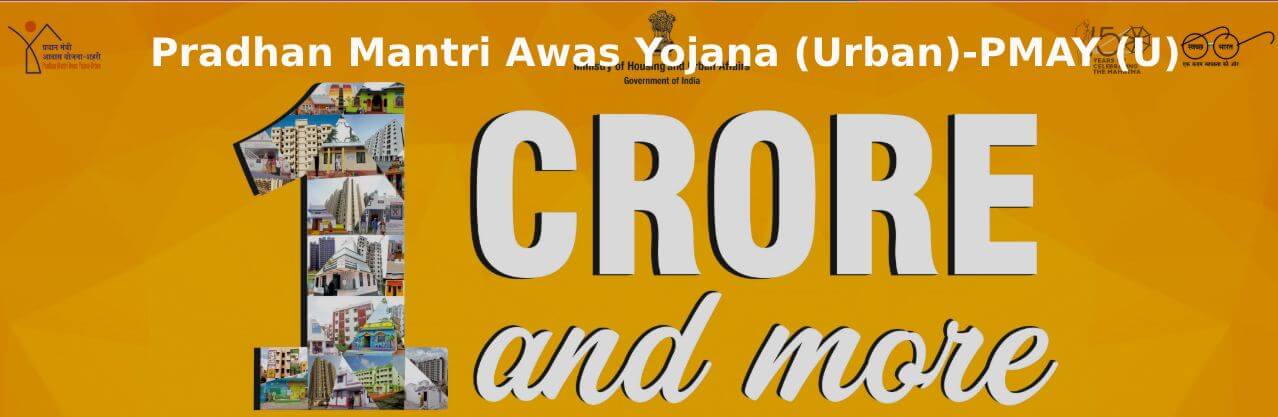
The Pradhan Mantri Awas Yojana, or PMAY scheme, aims to provide affordable housing for all by the year 2022. This is being achieved through a Credit Linked Subsidy Scheme where the government provides subsidy on the interest amount of home loans taken by eligible individuals, thus bringing down the interest component considerably. This scheme is available only to those who fit the eligibility parameters set by the government of India.
This makes home loans cheaper in the long run and brings down the Equated Monthly Instalment (EMI) as well, which means borrowers have more disposable income in hand after paying their monthly instalments on the home loans. This has made home ownership more affordable across different income categories. It has also increased ownership among women as that is one of the mandatory eligibility criteria for one of the categories.
Under the ‘'Housing for All by 2022’' vision of the government, one crore housing units will be constructed by the deadline out of which 53.79 lakh houses have already been sanctioned.
Income Categories
There is a fixed interest subsidy for each of the income categories. The three different income categories are the Lower Income Group (LIG), Middle Income Group (MIG), and Economically Weaker Section (EWS). As of now, only interest subsidies for the LIG and EWS categories have been notified. The MIG category, which will fall in the income range between Rs.12 lakh and Rs.18 lakh p.a., remains to be notified. The EWS income category is for households having an annual income of up to Rs.3 lakh. The LIG income category is for those having an annual household income of up to Rs.6 lakh.
Interest Subsidy
The interest subsidy currently available for loans of up to Rs.6 lakh is 6.5%. For those earning up to Rs.12 lakh, the interest subsidy is 4% for a loan amount of up to Rs.9 lakh. For those earning up to Rs.18 lakh, the interest subsidy is 3% for a loan of up to Rs.12 lakh.
This means that for additional loan amounts beyond the amount given above, the interest rate will be calculated as per the standard home loan interest rate by the banks. The tenure for all the loans of any income category is up to 20 years.
How interest subsidy is calculated
The interest subsidy amount is the Net Present Value (NPV) and not the differential of the interest amount. For this, the interest portion of each Equated Monthly Instalment has to be taken into account, which can be got from the amortisation table of the home loan.
Income of Rs.6 lakh
Let’s take an example of a home loan of up to Rs.6 lakh taken by someone with an annual income of up to Rs.6 lakh. If the interest rate on the home loan is 9% p.a., the EMI will be Rs.5,398 with an interest cover over 20 years of Rs.6.95 lakh.
If you take into account the interest subsidy of 6.5%, the NPV of the interest subsidy will then be Rs.2.67 lakh. This amount is what the government will offer to the borrower and is credited upfront to the borrower’s account. In effect, this brings down the loan amount that is to be repaid from Rs.6 lakh to Rs.3,33,000. However, the 9% interest rate is still applicable on this balance amount of Rs.3.33 lakh. So for this revised loan amount, at an interest rate of 9%, for a tenure of 20 years, the EMI will now be Rs.2,996, with a total interest to be paid back now being reduced to Rs.3.86 lakh. This is a savings of Rs.3,80,939 in total with a monthly reduction in EMI amounting to Rs.2,402.
Income of Rs.12 lakh
Let’s consider someone with an income of Rs.12 lakh taking a loan of Rs.9 lakh at an interest rate of 9% p.a. over a 20-year tenure and an interest subsidy of 4% under PMAY.
The total interest cover, before the subsidy is taken into account, would be Rs.10.43 lakh with an EMI of Rs.8,098. When you take the interest subsidy of 4% into account, the NPV comes to Rs.2.35 lakh which brings the loan amount down to Rs.6.65 lakh. Calculating the interest rate of 9% on this remaining amount, the EMI will now be Rs.5,983 with the total interest payable being Rs.7.70 lakh now. Thus, the total savings in interest will be Rs.2,72,445 and the savings in EMI will be Rs.2,114.
Income of Rs.18 lakh
If someone with an income of Rs.18 lakh takes a loan of Rs.12 lakh at an interest rate of 9% p.a. over a tenure of 20 years, the EMI will be Rs.10,796 with the total interest payable being Rs.13.91 lakh. If you consider the interest subsidy of 3% for this category, the NPV of the subsidy is Rs.2.3 lakh. This makes the reduced loan amount Rs.9.7 lakh on which if you calculate the interest of 9% p.a., you get an EMI of Rs.8,727, which is Rs.2,069 lower than what it would be without the subsidy. The total interest payable also comes down to Rs.11.24 lakh which is a savings of Rs.2,66,649.
Savings
With the Reserve Bank of India slashing repo rates and banks following suit by reducing interest rates on home loans, the actual interest rate will be lower than the 9% taken in the examples given above. This means that, combined with the CLSS, borrowers will be able to save even more money on their EMIs and total interest payable.
Comments
Post a Comment